Concrete Leveling Demystified: Crucial Info on Mudjacking and Polyjacking for Homeowners
Concrete progressing is a crucial facet of home upkeep, affecting both safety and security and look. House owners commonly deal with the challenge of choosing in between mudjacking and polyjacking for their concrete repair service needs. Each technique has its distinct procedures and benefits. Comprehending these differences can result in even more educated choices. As the discussion unfolds, the implications of these methods on long-term home security come to be progressively considerable. What will homeowners focus on in their concrete repair work remedies?
Recognizing Concrete Progressing: Why It Issues
While several house owners may overlook the significance of concrete leveling, understanding its importance is essential for keeping architectural stability and visual appeal. Uneven concrete surfaces can cause various problems, consisting of trip threats, water merging, and compromised foundations. These issues not only influence the security of citizens and visitors yet can likewise diminish the total value of a residential or commercial property.
In addition, neglecting concrete leveling can cause pricey fixings in time, as the underlying reasons of settling or sinking might intensify. Correctly leveled concrete improves the performance of outside rooms, driveways, and sidewalks, ensuring they continue to be aesthetically enticing and secure. Resolving leveling concerns promptly can avoid additional damages to surrounding structures and landscaping. House owners that focus on concrete leveling are making a smart investment in both their home's security and its lasting value, inevitably adding to an extra positive and practical living setting.
What Is Mudjacking?
Mudjacking is a concrete progressing method that involves infusing a combination of materials under sunken pieces to increase and stabilize them. This process offers numerous benefits, consisting of cost-effectiveness and minimal disruption to the surrounding location. It is especially optimal for situations where concrete surfaces have actually cleared up because of dirt disintegration or other environmental factors.
Refine Overview
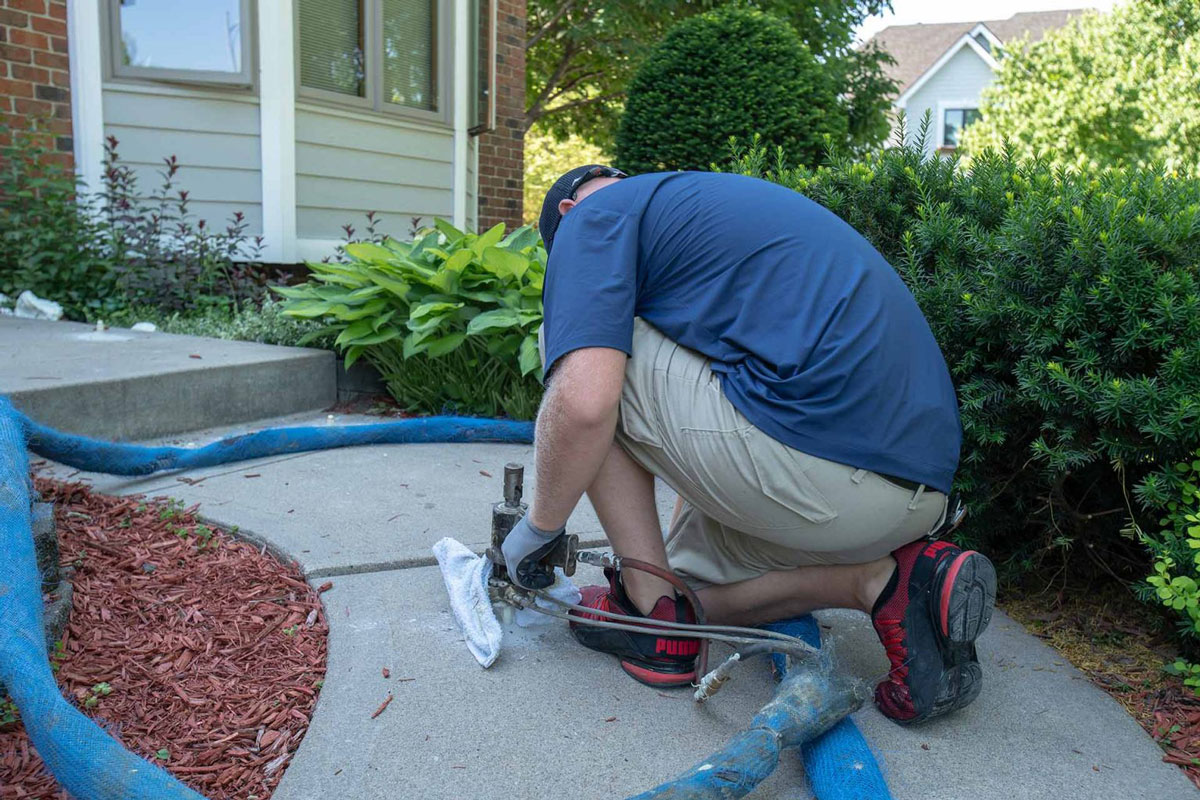
When concrete pieces sink or work out, mudjacking arises as a useful service to restore their level. The procedure includes infusing a combination, commonly made up of water, dirt, and cement, under the sunken slab. Originally, little openings are drilled right into the concrete surface, enabling accessibility for the injection. When the blend is pumped into deep spaces, it broadens and strengthens, effectively lifting the slab back to its original position - mudjacking vs polyjacking. This strategy is not only efficient yet likewise affordable compared to finish piece substitute. Mudjacking typically takes a couple of hours to complete, enabling house owners to use the surface soon after the process concludes. In general, mudjacking provides a dependable approach for attending to uneven concrete surface areas
Advantages of Mudjacking
Lots of home owners might not be familiar with the term, mudjacking deals numerous considerable advantages for dealing with sunken concrete slabs. This method is cost-efficient compared to complete piece substitute, making it a cost-effective option for many. Furthermore, mudjacking is a fairly fast process, often requiring marginal downtime, which can be useful for hectic families. The method also promotes ecological sustainability, as it uses existing products as opposed to needing brand-new concrete. Mudjacking enhances security and visual appeals by recovering the level of outdoor patios, pathways, and driveways, therefore protecting against potential trip threats. Overall, mudjacking is a functional remedy that improves building value while attending to underlying architectural problems with performance and effectiveness.
Ideal Situations for Use
Property owners encountering problems with unequal concrete slabs frequently locate mudjacking to be a practical solution. This method is specifically reliable for domestic homes experiencing clearing up problems, such as driveways, walkways, and patios. Areas with minor to moderate sinking are informative guide ideal candidates, as mudjacking restores the level without extensive disturbance. Furthermore, it appropriates for structures that have not continual severe damage, enabling stabilization prior to further degeneration happens. Mudjacking is additionally advantageous in situations where fast repair work are needed, as it typically calls for much less time than substitute. It is an economical choice, specifically when contrasted to complete concrete replacement. In general, mudjacking works as a practical option for house owners seeking to recover their concrete surface areas efficiently.
The Mudjacking Refine: Step-by-Step
Mudjacking, a prominent approach for training and supporting sunken concrete, includes a systematic procedure that guarantees effective results. The treatment starts with the assessment of the damaged area, where experts identify the degree of the sinking and the underlying issues. Next off, small holes are drilled into the concrete slab, usually spaced a couple of feet apart. Following this, a specialized mixture, often composed of cement, soil, and water, is pumped into these holes under stress. This mixture loads voids below the slab and increases the concrete to its original setting. As soon as the slab is lifted, the openings are filled and sealed to stop water seepage and additional disintegration. Lastly, the surface area is smoothed, and property owners are encouraged to prevent hefty traffic on the freshly leveled concrete for a brief period to guarantee proper curing. This approach is minimally invasive and reliable, making it a favored option for property owners attending to concrete problems.
Benefits of Mudjacking
Numerous advantages make mudjacking an attractive option for addressing sunken concrete. It is a cost-efficient approach compared to complete concrete substitute. House owners can save significant amounts of money while bring back the functionality and look of their concrete surface areas. Furthermore, mudjacking is a quick procedure, usually completed within a couple of hours, permitting homeowners to resume regular tasks without long term disturbance.
In addition, mudjacking utilizes environmentally friendly materials that lower ecological effect, making it a sustainable choice - BAM Basements. The method also supplies long-lasting outcomes, successfully dealing with spaces underneath the concrete and avoiding future sinking. Considering that mudjacking needs marginal excavation, it maintains the bordering landscape, making sure that yards and hardscapes stay undamaged. The treatment can be applied to various surface areas, consisting of driveways, patio areas, and sidewalks, boosting its adaptability. Jointly, these benefits position mudjacking as a sensible solution for homeowners dealing with irregular concrete
What Is Polyjacking?
Polyjacking is a modern-day strategy utilized for training and supporting cleared up concrete slabs. This process entails injecting a specialized foam under the concrete, which broadens and loads spaces, efficiently raising the surface. Comprehending the advantages of polyjacking can offer insight right into its growing appeal amongst contractors and house owners.

Polyjacking Refine Summary
A popular method for concrete progressing, polyjacking entails infusing a specialized polyurethane foam beneath irregular slabs. The procedure begins with piercing little holes into the influenced concrete surface. Once the holes are produced, a service technician inserts a hose connected to a pump, which infuses the expanding foam underneath the piece. As the foam expands, it fills spaces and raises the concrete to its initial position. The product treatments swiftly, commonly within a few hours, enabling for fast use the surface area. After the training procedure is full, the openings are filled up and secured to restore the concrete's appearance. Polyjacking is usually favored for its efficiency and marginal disturbance contrasted to conventional techniques of concrete repair.
Benefits of Polyjacking
The effectiveness of polyjacking hinges on its capability to rapidly restore concrete surface areas with marginal interruption. This technique utilizes a high-density polyurethane foam that sets and increases, supplying a tough structure for sinking concrete. Unlike typical mudjacking, polyjacking is lighter, reducing the danger of additional settling. Furthermore, it cures swiftly, allowing home owners to utilize their driveways, patio areas, or sidewalks almost promptly after application.
Polyjacking is also eco friendly, as the foam is composed of non-toxic products. Its resistance to water absorption helps protect against future damages from erosion. In addition, the longevity of polyjacking enhances its value, often outliving various other fixing techniques. Overall, polyjacking offers an efficient, long lasting, and economical solution for concrete progressing needs.
The Polyjacking Process: Step-by-Step
Various house owners look for reliable remedies for unequal concrete surfaces, and polyjacking has actually emerged as a preferred option. This approach entails a collection of systematic steps to recover concrete levels. The area is evaluated to identify the degree of the settling or training required. Next, small holes are pierced right into the influenced concrete piece to allow for polyurethane foam injection.
Once prepared, specialized tools infuses the foam under the slab, where it expands and fills spaces, efficiently elevating the concrete to its initial setting. The growth process is monitored closely to assure exact progressing. After the preferred elevation is accomplished, any type of excess foam is trimmed away, and the pierced holes are sealed. Lastly, the concrete surface area is permitted to treat, ensuring a sturdy and secure finish. This effective procedure decreases interruption, making polyjacking an appealing option for property owners looking to restore their concrete surfaces.
Comparing Mudjacking and Polyjacking: Which Is Right for You?
Exactly how can property owners decide in between mudjacking and polyjacking for their concrete leveling requirements? To make an educated selection, they need to consider several elements, including price, rate of installation, and the underlying reason for the concrete issue. Mudjacking commonly utilizes a mixture of cement, dirt, and other materials, offering a cost-effective remedy for bigger, more extensive projects. Nevertheless, it can take longer to heal and may not appropriate for smaller spaces.
On the other hand, polyjacking uses a light-weight polyurethane foam, which broadens to fill gaps rapidly. This method often tends to be extra expensive but offers much faster healing times and less disruption to the surrounding area. Homeowners must likewise analyze their long-lasting needs; polyjacking generally provides greater resilience and resistance to future settling. Inevitably, seeking advice from with a specialist can assist house owners figure out the very best method for their specific situation.
Regularly Asked Inquiries
For How Long Does Concrete Progressing Normally Last After the Process?
Concrete leveling normally lasts in between 5 to ten years, depending upon elements such as dirt conditions, environment, and upkeep. Timely repair work and regular assessments can extend the lifespan of the progressing process significantly.
Can I Do Mudjacking or Polyjacking Myself?
Mudjacking and polyjacking can be tried by property owners with the right devices and expertise. Nonetheless, expert aid is usually recommended to ensure safety, effectiveness, and lasting results, as the processes can be tough and intricate.
What Are the Costs Related To Mudjacking and Polyjacking?
Expenses associated with mudjacking and polyjacking generally range from $300 to $1,500, depending upon the size and complexity of the task. Home owners must think about extra elements like materials and labor when approximating complete expenses.
Exactly how Do I Know if My Concrete Demands Leveling?
Indications that concrete requirements leveling consist of visible fractures, uneven surface areas, pooling water, and gaps between pieces. Home owners must regularly evaluate sidewalks, driveways, and foundations for these signs to identify if leveling is needed.
Will Concrete Progressing Impact My Landscaping or Bordering Frameworks?
Concrete leveling can possibly affect landscaping and bordering frameworks, as the process might cause soil displacement or movement. Homeowners ought to examine their surroundings and consult specialists to reduce any kind of possible impact on their residential or commercial property.